

Your 7-week-old may be spending longer pockets of the day awake and aware, watching your face and perhaps offering the first hint of a smile. You may also be wondering what you are supposed to do with that alert time.
You do not need to entertain your baby continuously or turn every wakeful minute into a lesson. At this age, useful engagement can be as small as your face, your voice, a pause, and your response. The aim is to notice what your baby can take in, offer one simple experience, and stop when they have had enough.
At 7 weeks, engagement is a two-way exchange
A social smile is one possible response, but it is not the only sign that your baby is engaged. Social smiles commonly begin between 6 and 12 weeks. A smile that appears randomly during sleep is more likely to be reflexive, while one that repeatedly follows your face, voice, or smile is more likely to be social.
At around 7 weeks, babies may also study a caregiver’s face, turn toward sounds, coo, gurgle, or make vowel-like sounds. Those quieter reactions matter. Look for a change in your baby rather than one particular achievement:
- Your baby becomes still and watches your face.
- They turn their head or shift their attention toward your voice.
- They make a small sound after you speak.
- Their expression changes when you smile or sing.
- They move their arms or legs with excitement when you come close.
A serious expression does not mean the interaction has failed. Your baby may be concentrating. A delayed response does not mean they were not listening. Give them room to answer in whatever way they can.
Use an offer-pause-answer loop
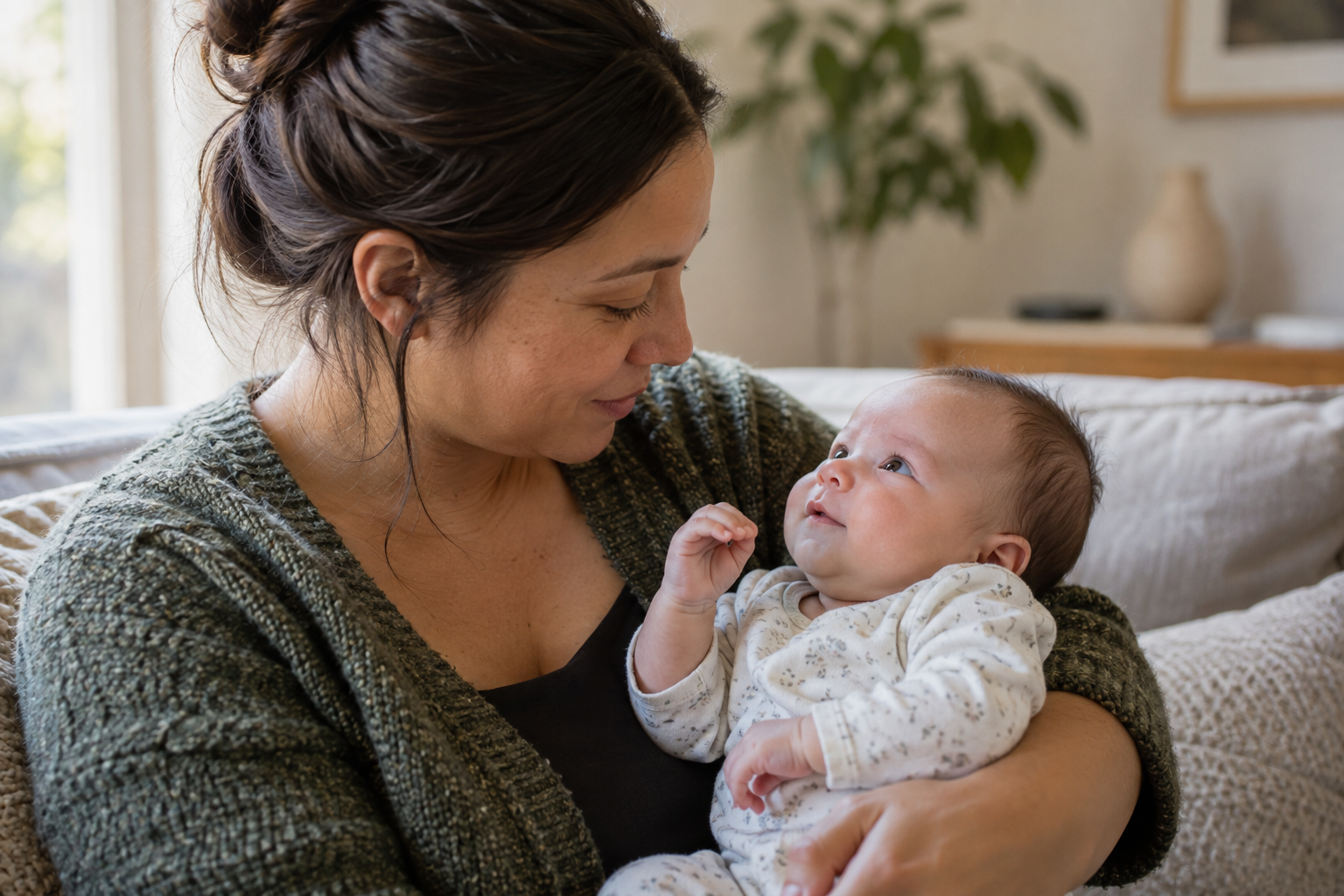
The simplest way to engage a young infant is to treat the interaction like a slow conversation. You offer one thing, wait, notice what changes, and answer. This keeps the activity responsive instead of overwhelming.
- Choose a workable moment. Begin when your baby is awake, relatively calm, and not signaling hunger or obvious tiredness. You do not need to create a special play period.
- Make your position comfortable. Hold or place your baby where they can comfortably see you. Continue supporting their head and neck; even if they are lifting their head during tummy time, they still need support when held.
- Offer one clear stimulus. Smile, say a short sentence, sing one line, or show one picture. Multiple toys, sounds, and movements at once make it harder to tell what your baby is responding to.
- Pause. Leave a quiet space after you speak or sing. Giving your baby time to respond is part of the interaction, even if the response is only a gaze, a small movement, or a coo.
- Answer what actually happened. Smile back, imitate the sound, or calmly describe what your baby is looking at. If they look away, let the exchange end instead of trying harder to recapture their attention.
One or two exchanges can be enough. Development is not measured by how long you can keep your baby interested.
Four simple ways to engage your baby
1. Have a face-to-face conversation
Talk through something already happening: a diaper change, getting dressed, or settling after a feed. Use a relaxed voice, smile naturally, and pause after a sentence. If your baby coos, make a similar sound and wait again.
This is not about teaching words yet. It gives your baby a manageable chance to connect your voice, face, and response. If no smile arrives, the watching and listening still count.
2. Read for voice and closeness, not for the plot
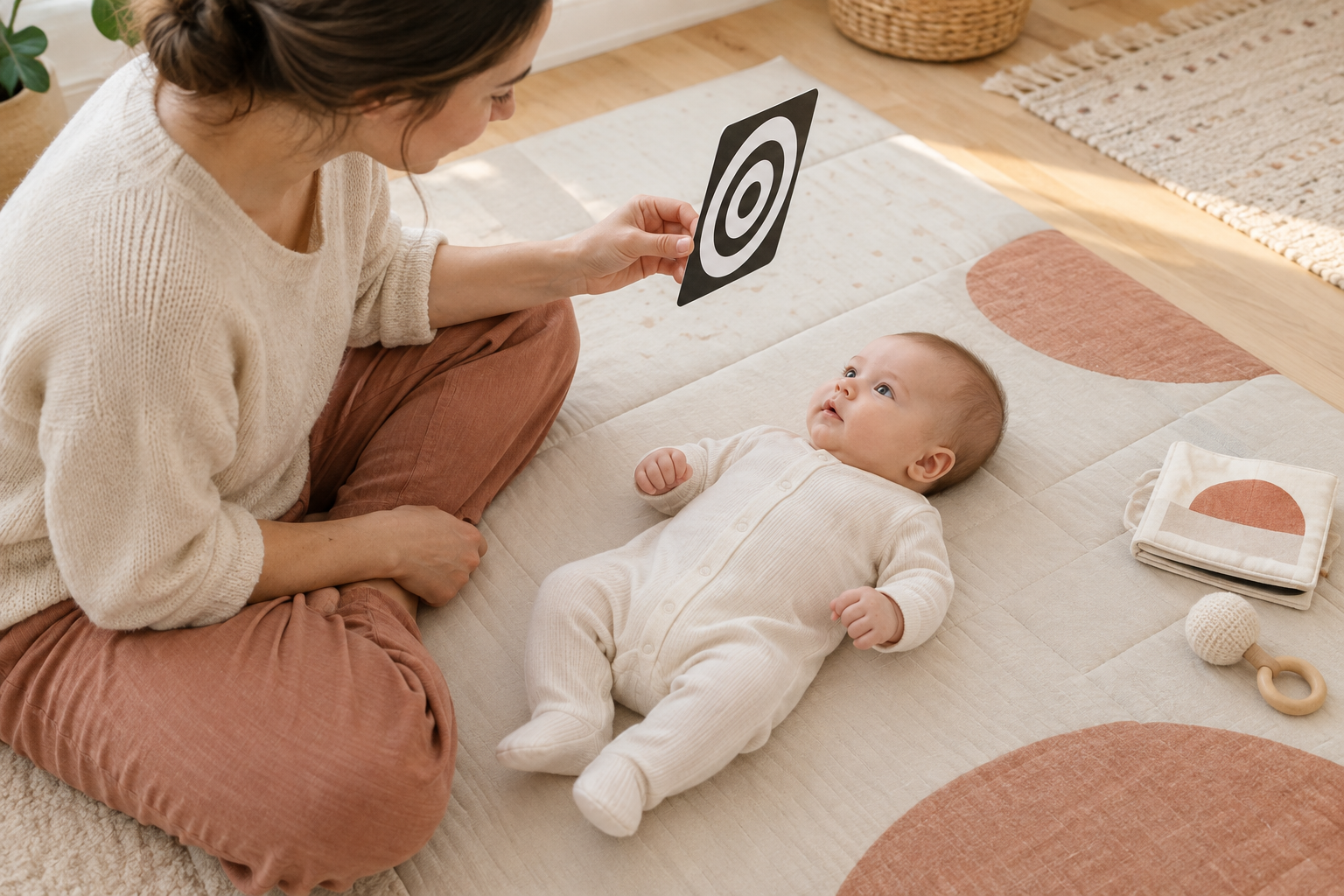
You can read to a baby from birth. For babies under 6 months, books with large, high-contrast pictures and little or no text suit developing vision. A sturdy book with an integrated mirror or peephole can also provide one clear thing to notice.
You do not have to finish the book, read every printed word, or keep your baby looking at the page. At this age, the sound and rhythm of your voice and the experience of being close to you matter more than understanding the story. You can even read aloud from your own book or magazine if that makes the habit easier to maintain.
Try showing one page, naming what you see, and pausing. If your baby looks elsewhere, close the book and move on. That is a complete reading session.
3. Let tummy time be both movement and interaction
At 7 weeks, some babies can lift their head for longer periods while on their stomach. You can make the experience more engaging by getting into your baby’s field of view and speaking or singing while they work.
Tummy time is only for when your baby is awake and directly supervised; it is not a sleep position. By 2 months, the cited developmental target is 15 to 30 minutes of tummy time in a day. If your baby’s clinician has given you different instructions, follow those. If your baby becomes distressed, end that attempt and try during another calm wakeful period.
4. Use your voice before adding more toys
A 7-week-old may watch you and turn toward sounds, so talking and singing are already substantial activities. Repeat a gentle sound, pause, and see whether your baby turns, stills, or vocalizes. A rattle or crinkly book can be introduced one at a time, but it is not required for a useful interaction.
Keeping the setup simple helps you read the response. If your face, voice, a bright toy, and music are all competing at once, you may miss the small cue that tells you what interested your baby.
Let your baby’s pause button count

Looking away is communication. Young babies may turn away when they are getting too much stimulation. They are not rejecting you, and you do not need to win their attention back.
When your baby repeatedly looks away, closes their eyes, becomes fussy, or starts crying, reduce the input. Stop moving the toy or book, quiet your voice, and give them time to settle. Check whether they need feeding, changing, sleep, or simply a break.
Direct eye contact can also feel intense for some babies. A baby who smiles without looking squarely at your face may still be taking in your voice, touch, and expressions. Follow their gaze instead of repeatedly repositioning their face toward yours.
Key takeaways
- Wait for a calm, wakeful moment; you do not need a formal activity schedule.
- Offer one face, sound, picture, or movement experience at a time.
- Pause long enough for a gaze, movement, sound, or expression to emerge.
- Treat looking away as a request for less stimulation, not a prompt to perform harder.
- Keep supporting your 7-week-old’s head and neck, even if head lifting has begun during tummy time.
- Read for closeness and the sound of language; finishing the book is optional.
Know when to raise a developmental concern

Seven weeks is inside a range, not a deadline. Some babies are already smiling socially, while others need more time. Babies born prematurely may also reach the smiling milestone later.
A single quiet day, brief interaction, or missed smile does not tell you whether development is on track. Watch the pattern over time. If your baby is not smiling by 3 months, mention it to their health care provider. If they are not maintaining your gaze by 6 months, that also warrants a conversation. Bring up concerns sooner if something about your baby’s responses, movement, hearing, vision, feeding, or general health worries you.
For your baby’s next calm wakeful stretch, choose just one thing: your face, a short song, a high-contrast page, or supervised tummy time. Offer it, pause, and let your baby’s response decide what happens next.
References
- Parents — When Do Babies Start Smiling and What Does It Mean for Development?
- Parents — Understanding Your 7-Week-Old Baby’s Key Milestones
- Parents — Start Reading to Your Baby Now: A Step-by-Step Guide for Every Age




