
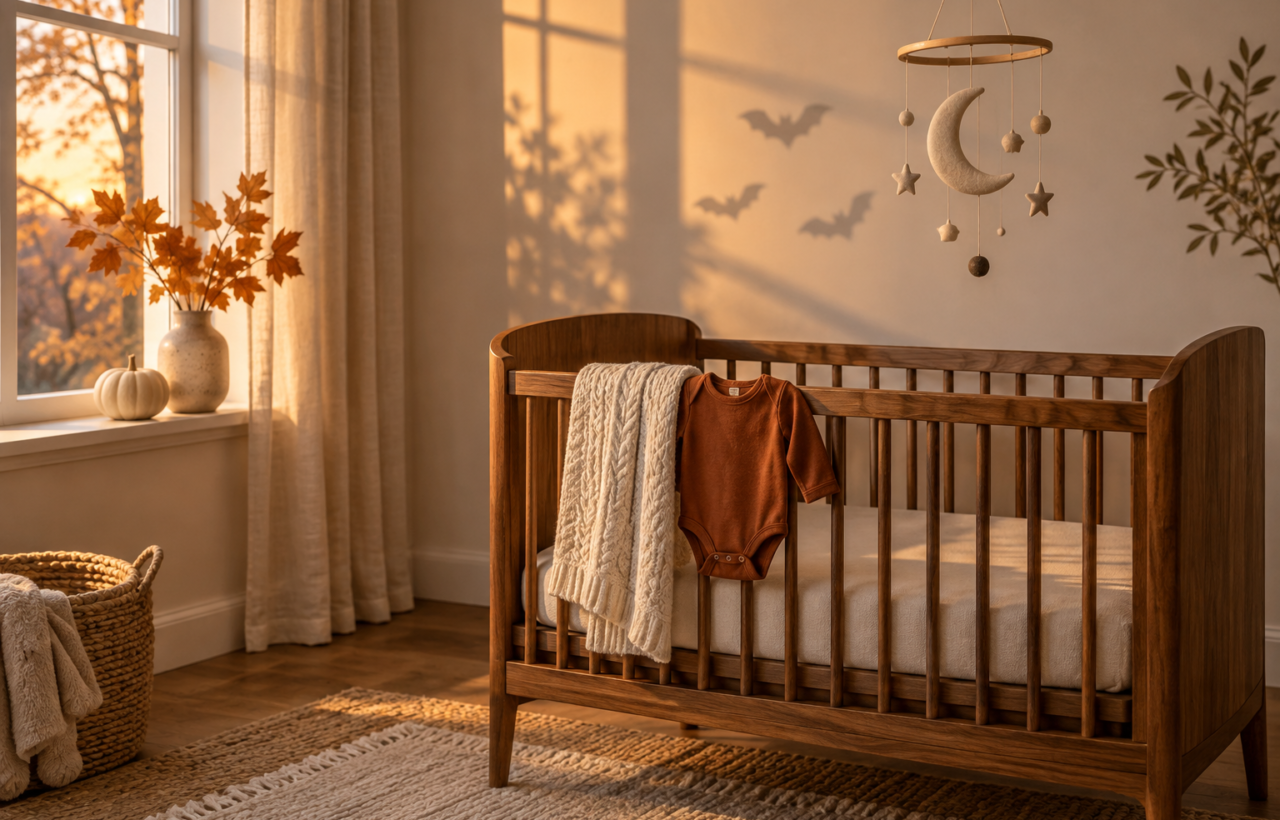
You love Halloween, but you don’t want your child’s name to feel like a costume that never comes off. Aim for a name that works in every month and carries an extra spark in October.
The strongest shortlist starts with tone, not a giant scroll of possibilities. Halloween inspiration spans classic gothic and modern mysterious names, which gives you plenty of room between a quiet autumn reference and an unmistakable horror homage.
First, choose how visible the Halloween connection should be

Before debating individual names, agree on how quickly another person should notice the theme. A name can carry Halloween through atmosphere, through a literary connection, or through an immediately recognizable character.
- Subtle: The connection lives in autumn color, trees, firelight, or another seasonal detail. The name works without an explanation.
- Atmospheric: The name feels moonlit, old-world, mysterious, or gothic, but it is not tied to a single Halloween character.
- Direct: The name clearly points to October, a supernatural figure, a famous fictional character, or an established horror story.
Pick a lane together before you make a shortlist. If one naming parent wants subtle and the other wants direct, trading random suggestions will not solve the real disagreement. Decide whether the reference should be apparent on sight, recognizable after a hint, or entirely private.
The more immediate the association, the more important it is that you genuinely like the association outside Halloween. A direct name may invite the same comment whenever your child is introduced. That is not automatically a reason to reject it, but it should be a deliberate choice.
A Halloween-inspired shortlist for four different moods

Use these names to find your preferred level of intensity. Do not keep a candidate simply because it fits the theme. Keep it only if you also like its sound, spelling, possible nicknames, and rhythm with your surname.
Quietly autumnal
- Autumn: The clearest seasonal choice. It feels warm and complete without requiring a spooky explanation.
- Hazel: Autumnal in color and botanical in character, with no fixed Halloween character attached.
- Rowan: A crisp tree name with a lightly magical quality rather than an overtly frightening one.
- Ivy: Compact, botanical, and slightly old-world.
- Amber: Warm and glowing, with a seasonal connection that stays understated.
- Ash: A short, flexible name that can evoke both a tree and fire.
- Ember: Firelit and modern. It carries atmosphere without sounding like a costume.
- Sage: A restrained botanical option with a quiet magical edge.
Moonlit and mysterious
- Luna: A direct moon reference with a soft, familiar sound.
- Selene: A more formal celestial choice with a mythological moon connection.
- Vesper: Polished and evening-toned, with a darker mood that is not obviously Halloween-themed.
- Raven: A recognizable dark bird name with strong gothic atmosphere.
- Onyx: A gemstone name with a sleek, shadowy edge.
- Briar: Botanical but thorny, giving it a fairy-tale darkness.
- Sable: A smooth, elegant word name with a dark visual quality.
Literary and gothic
- Bram: A compact nod to Bram Stoker. The horror connection is clear to readers who recognize it, but the name can stand on its own.
- Edgar: Established and old-fashioned, with an easy connection to Edgar Allan Poe.
- Lenore: Lyrical and melancholy, with a strong Poe association for literary readers.
- Dorian: Polished on the surface, with the gothic weight of The Picture of Dorian Gray beneath it.
- Victor: A conventional name that hides a Frankenstein reference in plain sight through Victor Frankenstein.
- Mary: A very subtle way to honor Mary Shelley and the imagination behind Frankenstein.
- Carmilla: Romantic and haunting, with an unmistakable vampire-literature connection for those who know the story.
Playful and unmistakable
- Jack: An everyday classic with a seasonal route to the jack-o’-lantern.
- Wednesday: A stylish day name whose Addams-family association will be the first thing many people notice.
- Morticia: A full commitment to the Addams connection. It is theatrical by design, not a subtle reference.
- Sabrina: Wearable beyond October, though its witchy pop-culture associations are hard to miss.
- Casper: Gentle in sound, with an immediate ghost association.
- October: A literal seasonal word name that makes the inspiration part of every introduction.
- Midnight: Dramatic and atmospheric, with more weight in formal settings than a conventional name.
- Salem: Short and striking, but loaded with historical and supernatural associations that you should be comfortable discussing.
A direct name does not need to pass as conventional. It does need to be more than a clever reference. If you love Wednesday only because you love the character, ask whether you also love saying and writing the name when the character is not part of the conversation.
Pressure-test the name before you commit

A Halloween connection should be the bonus, not the only reason a name survives. Run every serious candidate through the same practical checks so that a dramatic favorite and a familiar favorite receive equal treatment.
- Say the complete name in ordinary settings. Add the surname and use it in a daycare sign-in, a team roster, a graduation announcement, and a work introduction. The name does not have to sound conventional everywhere, but you should hear the tradeoff before choosing it.
- Test pronunciation without coaching. Show the written name to people who have not heard you say it. If readers pause in different places or repeatedly choose another pronunciation, decide whether correcting them will bother you.
- Ask for the first association. Ask what comes to mind before revealing the Halloween theme. An unprompted answer tells you how much cultural baggage the name carries. If the common reaction makes you defensive, move toward a subtler option.
- Inspect the initials and quick pronunciation. Write the initials, imagine an email-style abbreviation, and say the first and last names quickly. This catches accidental words, repeated sounds, and awkward collisions that are easy to miss on a curated list.
- List the likely short forms. Include affectionate family versions, obvious rhymes, and any nickname you already dislike. You cannot control every nickname, but you can notice the most natural possibilities in advance.
- Use the candidate in ordinary sentences. Try it privately for several days in phrases you will actually say. Notice whether the name becomes more natural or whether you keep explaining the idea behind it to yourselves.
- Protect every naming parent’s veto. Each person can sort candidates into love, could use, and firm no. Build from the overlap instead of bargaining around a firm no. Your child’s name is not a useful place for either parent to win a standoff.
Put the boldest reference in the middle when needed
The middle-name position is useful when you love a Halloween reference but are unsure about making it the name your child uses in every interaction. October, Raven, Wednesday, or Midnight can preserve the story while a more familiar first name provides day-to-day flexibility.
You can also reverse that pattern: use the atmospheric name first and ground it with a family middle name. Read the entire combination with the surname. Rhythm matters more in real life than a perfectly coordinated theme does on paper.
Run one final thought experiment. If the character, book, or seasonal connection stopped being culturally familiar, would you still love the name’s sound and feel? If the answer is no, the reference may be doing more work than the name itself.
Key takeaways
- Decide whether you want a subtle, atmospheric, literary, or direct Halloween connection before comparing individual names.
- Keep only names you would still enjoy hearing and using outside October.
- Say each complete name in both childhood and adult settings, then inspect its initials, rhythm, spelling, and likely nicknames.
- Ask other people for their first association without telling them the theme; their unprompted reactions reveal how visible the reference really is.
- Use the middle-name position when the bold reference matters to you but feels too demanding for daily use.
Choose your lane, keep the candidates you would be happy to call across a playground and place on a school form, and try each complete name in ordinary sentences. When a name feels like your child’s name before it feels like a theme, you have a serious contender.
References




