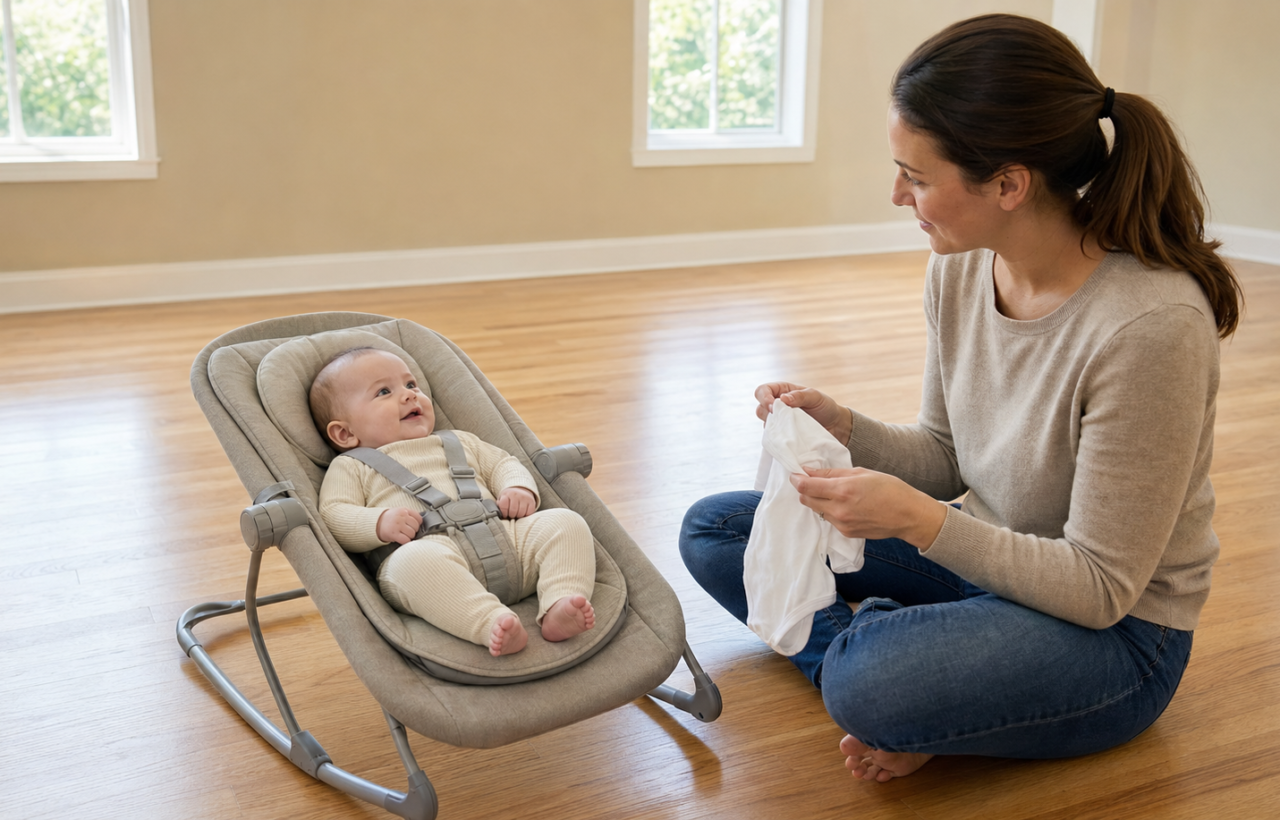
You may be considering a rocker because your baby settles with motion and you need both hands for a brief task. The useful question is not whether the seat has enough toys or settings. It is whether you can use it as a short, supervised place for an awake baby without letting it become an accidental sleep space.
A good rocker solves that narrow problem and fits safely into your home. Choose it by checking the limits, harness, recline, stability, cleaning instructions and footprint. Then make a plan for where it will sit, how you will supervise your baby and what you will do if your baby falls asleep.
Key takeaways
- Use a rocker only for supervised awake time. It is not a crib, bassinet or substitute sleep space.
- Place it on a flat, hard floor, fasten the harness every time and remove your baby before moving the seat.
- If your baby falls asleep, transfer them to an appropriate sleep space: on their back, on a firm and flat surface, without loose items around them.
- For a newborn, use the most reclined setting available and watch head position, posture and breathing.
- Stop at the earliest applicable limit: independent sitting, the product’s maximum weight, the end of its stated age range or any sign of damage or instability.
- Prioritize clear safety information, a complete harness, washable fabric and a practical footprint before entertainment features.
Make sure a rocker is the category you actually need
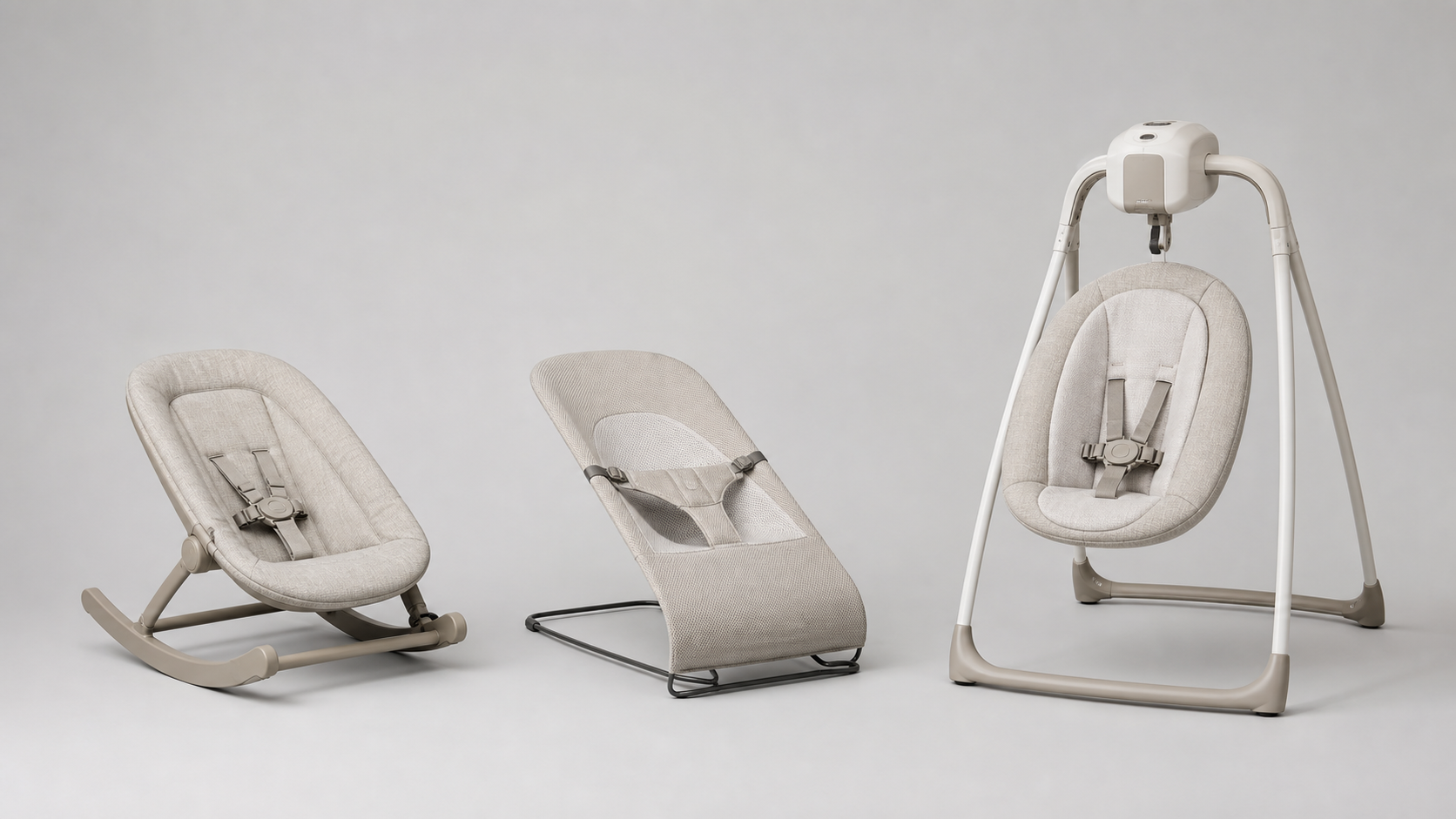
Rocker, bouncer and swing are often used as if they mean the same thing, but their movement and practical tradeoffs differ. A rocker usually has a curved base and moves back and forth when a caregiver nudges it. A bouncer typically moves up and down, often in response to the baby’s kicks. A swing generally uses power to move automatically.
| Seat type | How it usually moves | What to consider |
|---|---|---|
| Rocker | A curved base rocks after a caregiver’s push | Often simpler and easier to move when empty, but the baby still needs close supervision |
| Bouncer | A flatter base produces an up-and-down motion, sometimes from the baby’s movement | Useful for a baby who enjoys responsive movement, but still a container rather than a sleep surface |
| Swing | A powered or partly powered mechanism moves the seat automatically | May offer more motion choices, but usually needs power and more floor space |
Choose by the job you need the product to do. If you want gentle motion during short periods while you remain nearby, a simple rocker may be enough. If automatic movement is important, you may really be shopping for a swing. If space is tight or you expect to travel with the seat, weight, folded size and power requirements matter more than a long feature list.
None of these seats replaces holding, floor play or a safe place to sleep. A rocker is convenience gear, not a newborn essential. Before buying one, identify a recurring situation it will solve and the flat floor space where you will use it. If you cannot name both, the seat may become one more bulky item rather than a useful part of your routine.
Put sleep, placement and restraint ahead of soothing
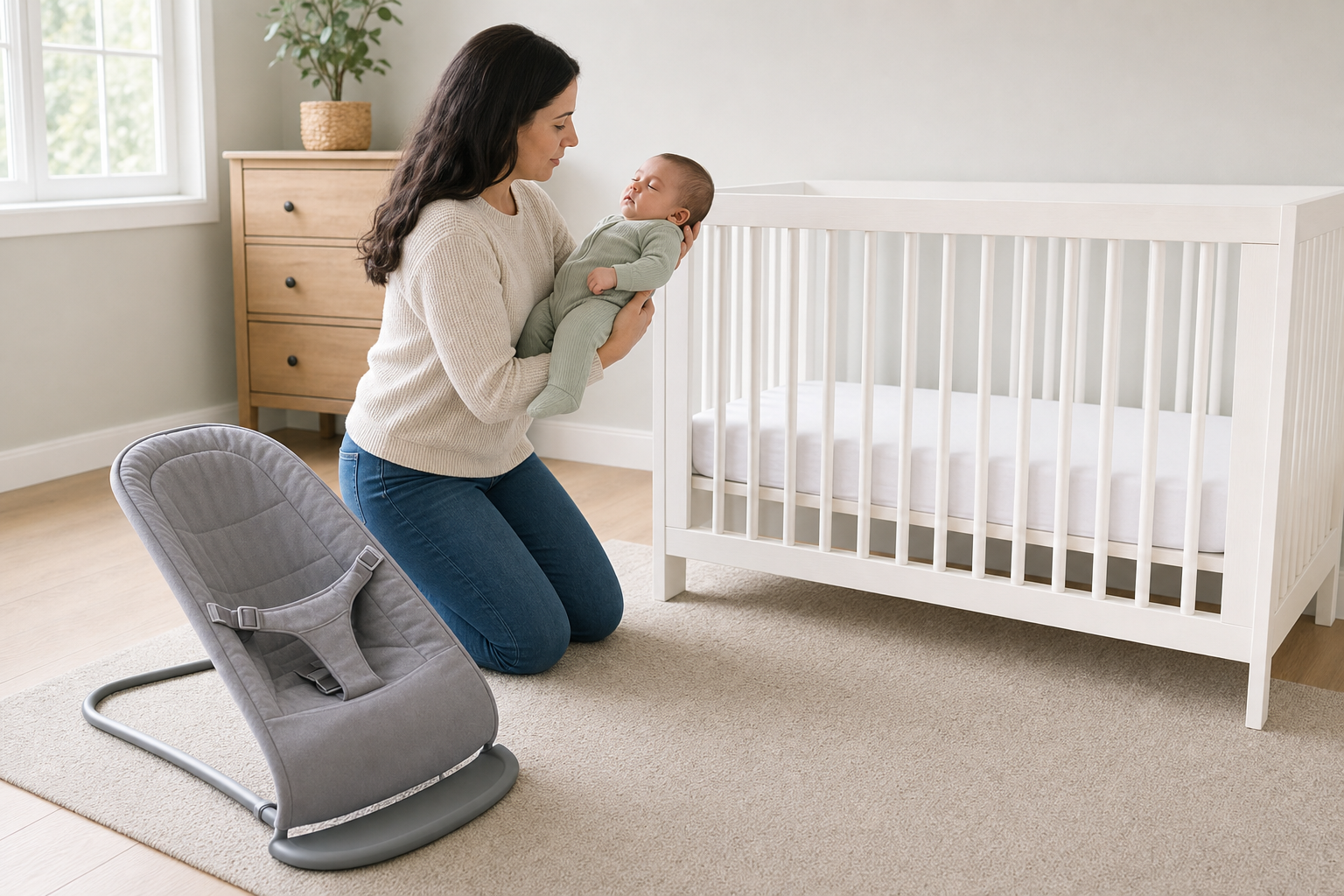
The most important boundary is simple: a baby rocker is for an awake baby under supervision. Its reclined seat does not provide the firm, flat surface required for safe sleep. A young baby’s head can fall forward in an inclined position, which can interfere with breathing.
If your baby falls asleep, move them to an appropriate sleep space even if the transfer risks waking them. Place the baby on their back on a firm, flat surface without loose objects in the sleep area. A peaceful-looking baby is not evidence that an inclined seat has become safe for a nap.
Decide where the rocker will live before the first use. It belongs on a flat, hard floor. Do not put it on a table, counter, couch, bed or other elevated or soft surface. A shift or tip is much more dangerous when the seat can fall from a height, and a soft surface can make the base less stable.
Use the harness every time, including when your baby is calm and not yet very mobile. It should be snug enough to hold the baby in the intended position without being uncomfortably tight. A loose harness cannot reliably prevent sliding or shifting, while an incorrect fit may also leave the baby’s posture unsupported.
For a newborn without strong head and neck control, select the most reclined position available for that model. Stay close enough to notice whether the head is dropping forward, the body is sliding or breathing and posture look different. If your baby’s head repeatedly falls forward despite correct setup and harness use, stop using the rocker. Ask your pediatric healthcare professional about safe positioning before trying it again.
Move the rocker only when it is empty. Take your baby out, relocate the seat, confirm that the base is stable and then put the baby back in. Carrying or dragging the entire seat with a baby strapped inside turns a routine room change into an avoidable fall or tipping risk.
Buy for fit, stability and cleanup, not extra gadgets
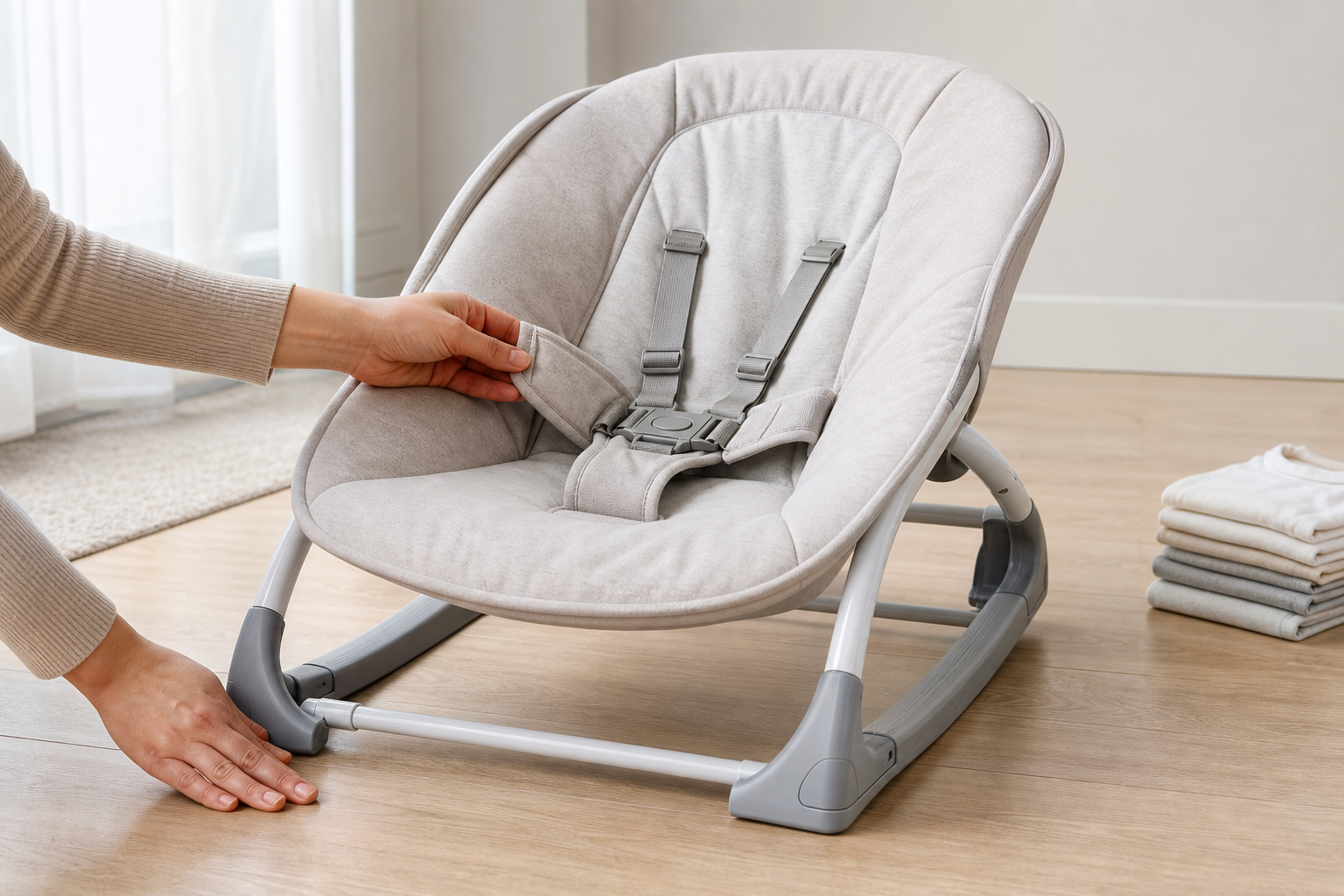
A product listing can make music, toy bars and premium fabric look like the decision. Start with the information that determines whether the rocker is suitable for your baby and your space.
- Read the age, weight and milestone limits. Many rockers are designed for use from birth until roughly six months, but that is not a universal permission slip. The individual model’s instructions control, and use may need to end sooner when a baby can sit independently.
- Examine the complete harness. Make sure the buckle closes properly, the straps adjust to your baby and no required part is missing, frayed or damaged. Do not improvise a replacement restraint.
- Check the base and frame. The assembled rocker should feel stable on the floor. Damaged joints, loose components, cracks or an uneven base are reasons not to use it.
- Confirm the recline options. If you are buying for a newborn, the model needs a suitable reclined position. A more upright seat should not be treated as close enough when your baby cannot yet control their head and neck.
- Read the cleaning instructions. A removable, machine-washable cover is a practical feature because feeding spills, spit-up and diaper leaks are ordinary parts of using baby gear.
- Look for clear safety information. If you are shopping in the United States, Canada or Mexico, JPMA certification is one useful signal to check. Certified products are sample tested by an independent laboratory annually or after a material change. Certification does not replace the model’s instructions, limits or supervision requirements.
- Compare the real dimensions with your floor space. Check where the base will sit without blocking the path through the room. If you expect to travel or move the empty rocker frequently, a lighter or foldable design may be more valuable than extra entertainment features.
Brand transparency matters. You should be able to find the product’s limits, restraint instructions, cleaning method and applicable safety information before paying. If those basics are vague, choose a model that makes them clear.
Be stricter with a secondhand rocker
A used rocker is not a bargain if you cannot verify how to use it safely. Check that the age and weight information is readable, the seat can be assembled as intended, every strap and buckle is present, and the base does not wobble. Skip a seat with missing restraints, damaged parts or unexplained instability. Those are structural problems, not cosmetic flaws.
Use a repeatable routine and know when the rocker is finished
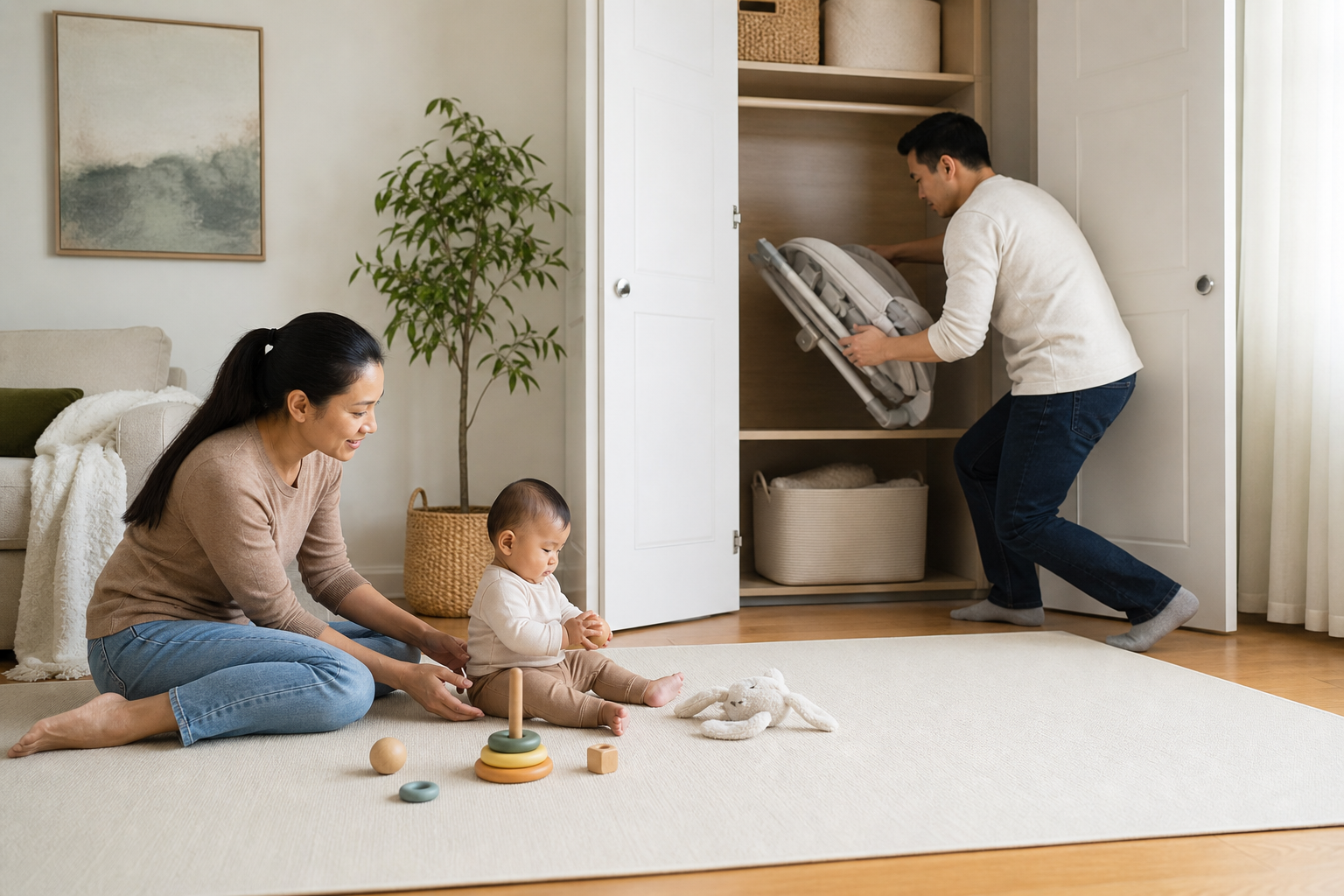
Check the setup before every session
- Place the rocker on its designated flat, hard floor area where you can supervise your baby.
- Check that the base is stable and the seat, frame, harness and buckle are undamaged.
- Select the appropriate recline, using the most reclined available setting for a very young infant.
- Position your baby according to the model’s instructions and fasten the harness snugly.
- Watch posture and breathing throughout the session. End it if your baby slides, slumps or cannot maintain a safe head position.
- If your baby falls asleep, transfer them to a firm, flat sleep surface and place them on their back.
Keep rocker time in proportion
A rocker should fill short gaps in the day, not become the place where your baby spends every quiet period. One hour is sometimes used as an upper guideline for avoiding too much time in the same position, and some pediatricians recommend shorter stretches in baby containers. Treat that hour as an outside boundary, not a target.
Rotate between activities with different purposes. The rocker can provide a brief contained pause while your baby is awake. Floor play allows freer movement. Feeding, cuddling and sleep each belong in settings suited to those needs. This rotation also makes it less likely that convenience will quietly turn into prolonged containment.
Stop at the first limit your baby reaches
Do not wait for every limit to apply. End rocker use when your baby reaches the stated maximum weight, reaches the end of the model’s age range, can sit independently or otherwise exceeds the manufacturer’s instructions. For many families, independent sitting arrives before the approximate six-month endpoint, which means the milestone ends use even if the baby remains below the weight limit.
Damage can end use at any age. Retire the rocker if the restraint no longer works, a required part is missing or the frame and base cannot remain stable. The same applies when your baby no longer fits in the intended position or repeatedly slumps despite correct adjustment.
If you decide to buy a rocker, prepare the safe routine before your baby uses it: choose its floor location, learn the harness, read the stopping limits and keep an appropriate sleep space ready for transfers. The rocker is most useful when its role stays narrow – a brief, supervised seat for an awake baby – and when you are ready to stop using it as soon as that role no longer fits.