
You speak to your baby and get no reaction. A moment later, a cupboard closes and they jump. That mixed pattern is exactly why hearing concerns are difficult to judge at home: a baby can respond to some sounds and still need a proper hearing assessment.
One missed response does not diagnose hearing loss, but a repeated pattern deserves attention. Write down what you are noticing, contact your baby’s health-care provider, and ask whether a hearing evaluation is appropriate. Identifying hearing loss early can make a meaningful difference because it gives your child earlier access to treatment and communication support.
Key takeaways
- A reaction to some sounds does not prove that your baby hears every sound clearly or equally in both ears.
- Look for a persistent pattern across ordinary moments rather than repeatedly making loud noises to test your baby.
- A newborn hearing-screen result describes hearing at the time of that screening; later concerns still deserve assessment.
- You do not need to prove that hearing loss is present before asking for help. Specific examples are enough to start the conversation.
Notice a pattern, not a single missed response

Hearing loss is not always complete silence. It may affect one ear or both, and a baby may hear certain sounds more easily than others. That is why a response to music, a barking dog, or a dropped object cannot rule out a hearing problem.
Sleep, hunger, background noise, distance and intense visual focus can also change how a baby responds. The useful question is not whether your baby reacted every time. It is whether the same concern keeps appearing when your baby is awake, settled and able to pay attention.
- In early infancy: notice whether your baby rarely reacts to voices or everyday sounds, seems much more responsive to vibration or visual movement, or consistently responds more from one side than the other.
- As your baby becomes more interactive: notice whether they respond readily when they can see you but often do not react when you speak from outside their field of view. Also mention babbling or vocal development that seems to have stalled.
- In the toddler stage: watch for a repeated need to see your face before following simple communication, limited progress in spoken language, or an apparent failure to notice sounds that other people hear easily.
None of these observations confirms hearing loss on its own. Attention, temperament, language development and other health issues can create similar patterns. However, persistent signs of possible hearing loss are worth investigating, especially when you notice a change from your baby’s usual behaviour.
Speech or language delay is also not a reason to assume hearing loss, but hearing should be considered when communication is not progressing as expected. Waiting to see whether your child eventually talks can postpone an assessment that does not require your child to speak.
What to do when you are concerned

You will give the clinician more useful information by describing ordinary situations than by saying only that your baby sometimes ignores you. Use this sequence:
- Record several recent examples. Note what the sound was, where it came from, whether the room was quiet, whether your baby could see the person making it, and what response you expected.
- Notice whether one side seems different. Do not conduct a loud test. Simply mention if your baby appears to notice voices or toys more reliably from one direction during normal activity.
- Gather the information you already have. Bring the newborn hearing-screen result if it is available, along with relevant medical records and details about recent ear problems or changes in behaviour.
- Contact your baby’s primary health-care provider. Explain that the pattern is recurring and ask whether an ear examination and a formal assessment by an audiologist who evaluates infants are needed.
- Leave with a defined next step. If immediate testing is not recommended, ask what you should monitor, when the concern should be reviewed, and what would trigger a referral.
A naturally occurring video may help illustrate what you mean, but do not delay the call while trying to capture perfect evidence. Your observations are a starting point, not a diagnostic test.
Do not repeatedly clap, shout, whistle or bang objects near your baby’s ears. A startle response does not measure hearing accurately, and unnecessarily loud sound can be harmful. Do not place cotton swabs, drops or other objects in the ear unless a qualified health professional has specifically advised you to do so.
If your baby suddenly stops responding to sounds they previously noticed, contact a health professional promptly rather than waiting for the next routine appointment. If the change follows an injury or appears alongside signs of serious illness, use the urgent or emergency care available where you live.
What an infant hearing assessment can answer
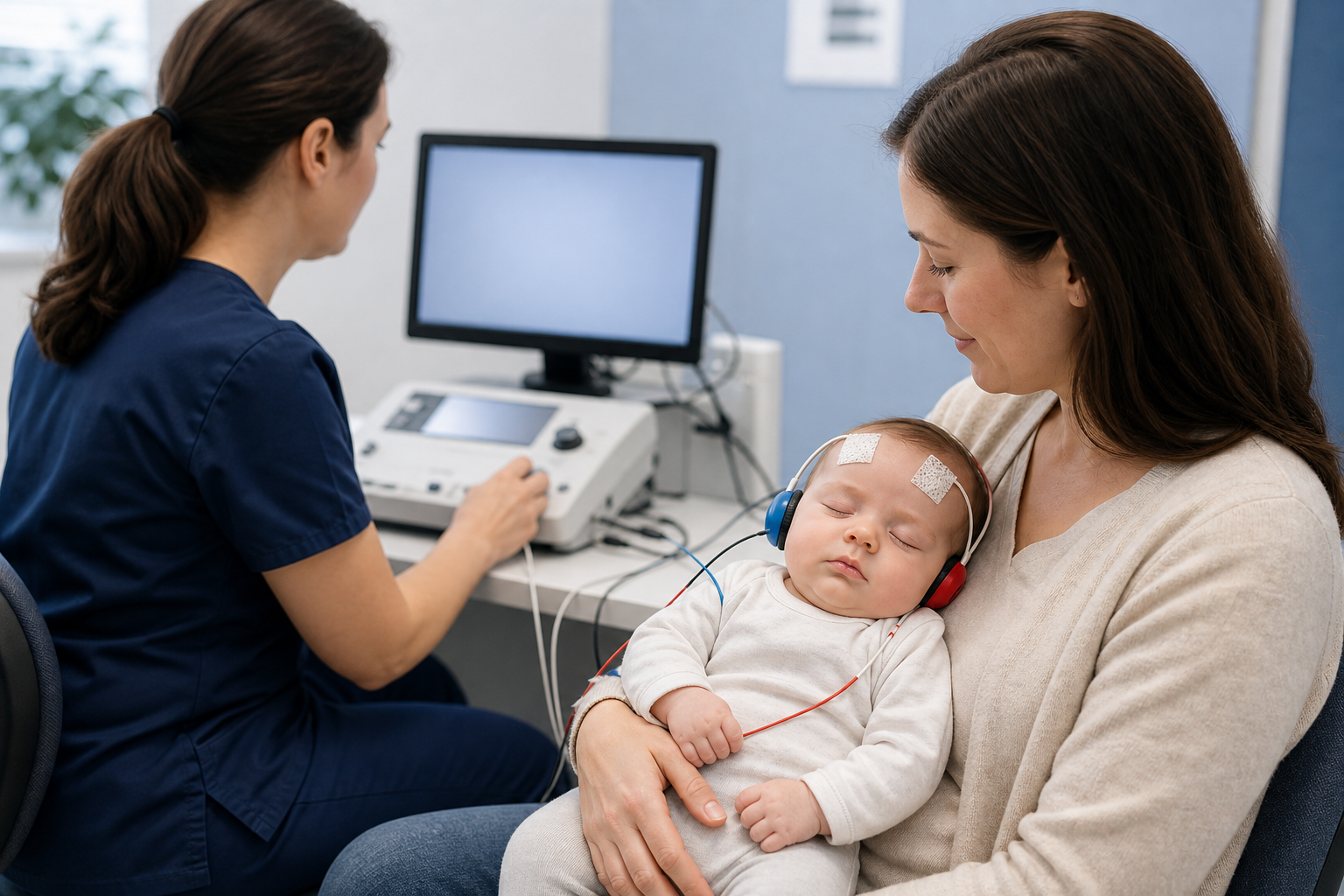
A routine ear examination and a hearing assessment answer different questions. An ear examination may identify blockage or signs of a problem in the outer or middle ear. It cannot, by itself, create a complete picture of how your baby detects sound.
Infants do not need to talk, follow adult instructions or raise a hand to have their hearing assessed. Depending on the baby’s age and the question being investigated, testing can use sensors that measure physical responses from the ear or hearing pathway, observation of developmentally appropriate responses to sound, or a combination of methods. The aim is to examine each ear rather than relying on a general reaction to noise.
Before the appointment, ask whether the clinic needs your baby to be asleep, settled or prepared in a particular way. Follow the clinic’s feeding and sleep instructions rather than changing your baby’s routine on your own. Bring previous hearing results and anything you normally use to soothe your baby.
A newborn hearing screen is an important first check, but it is still a screen. A pass means that your baby’s responses met the screening criteria at that time. It does not provide a permanent guarantee, and it does not make later observations irrelevant. Hearing difficulties can also differ in degree or affect one ear, which may make them less obvious during daily life.
When results are explained, ask for plain answers to these questions:
- Was each ear assessed separately?
- Does the result indicate conductive, sensorineural or mixed hearing loss, or is more testing needed?
- What can my baby hear now, and what remains uncertain?
- Could the finding be temporary, and when should testing be repeated?
- Which clinician or service is responsible for the next step?
- What communication support can begin while we wait?
- Which changes should prompt an earlier call?
If the explanation is limited to pass, fail or come back later, ask what that wording means for each ear and what the follow-up timeline is. A written plan is especially useful when several services are involved.
Treatment depends on where the hearing problem begins
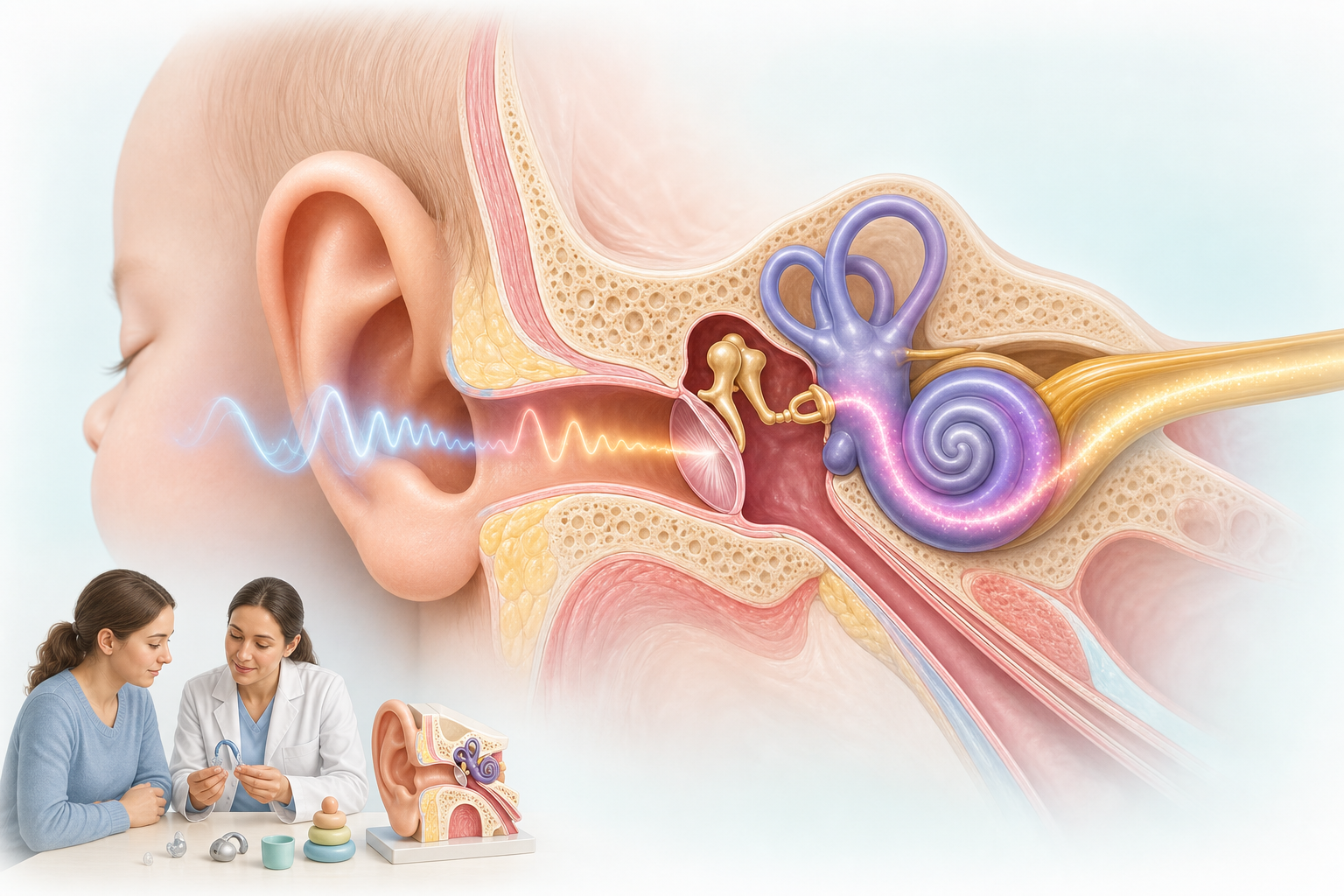
There is no single treatment for infant hearing loss. The appropriate plan depends on the part of the hearing system involved, whether one or both ears are affected, the degree of hearing loss, and whether the change is expected to be temporary or ongoing.
- Conductive hearing loss involves sound being reduced or blocked in the outer or middle ear. Blockage, fluid and other ear conditions may need medical treatment, monitoring or a procedure, depending on the cause.
- Sensorineural hearing loss involves the inner ear or the pathway carrying sound information toward the brain. Management may include hearing technology and early communication support. Hearing aids are an option for some children, while cochlear implants may be considered for some children after specialist assessment.
- Mixed hearing loss includes both conductive and sensorineural components, so the care plan may need to address each component separately.
The available treatment options vary with the cause and the child’s needs. A device or procedure is not the whole plan. Your child also needs reliable access to communication while decisions, fittings or follow-up assessments are underway.
Communication support may involve sign language, spoken-language support or a combination chosen with your family and your child’s professional team. The goal is not to wait for one perfect intervention before communicating. It is to make everyday interaction as clear and accessible as possible while the longer-term plan takes shape.
Ask who will coordinate audiology, medical care and early communication services, and put the next appointment date in writing. If a proposed plan is to monitor the situation, make sure monitor has a concrete meaning: what is being watched, who will reassess it, and when that reassessment will happen.
If you have a concern today, you can send a simple message to your baby’s clinician: My baby repeatedly does not respond to voices or sounds in these situations, and I would like to know whether a hearing assessment is needed. Add your clearest examples. You do not need to settle the diagnosis before making the call; that is what the assessment is for.