
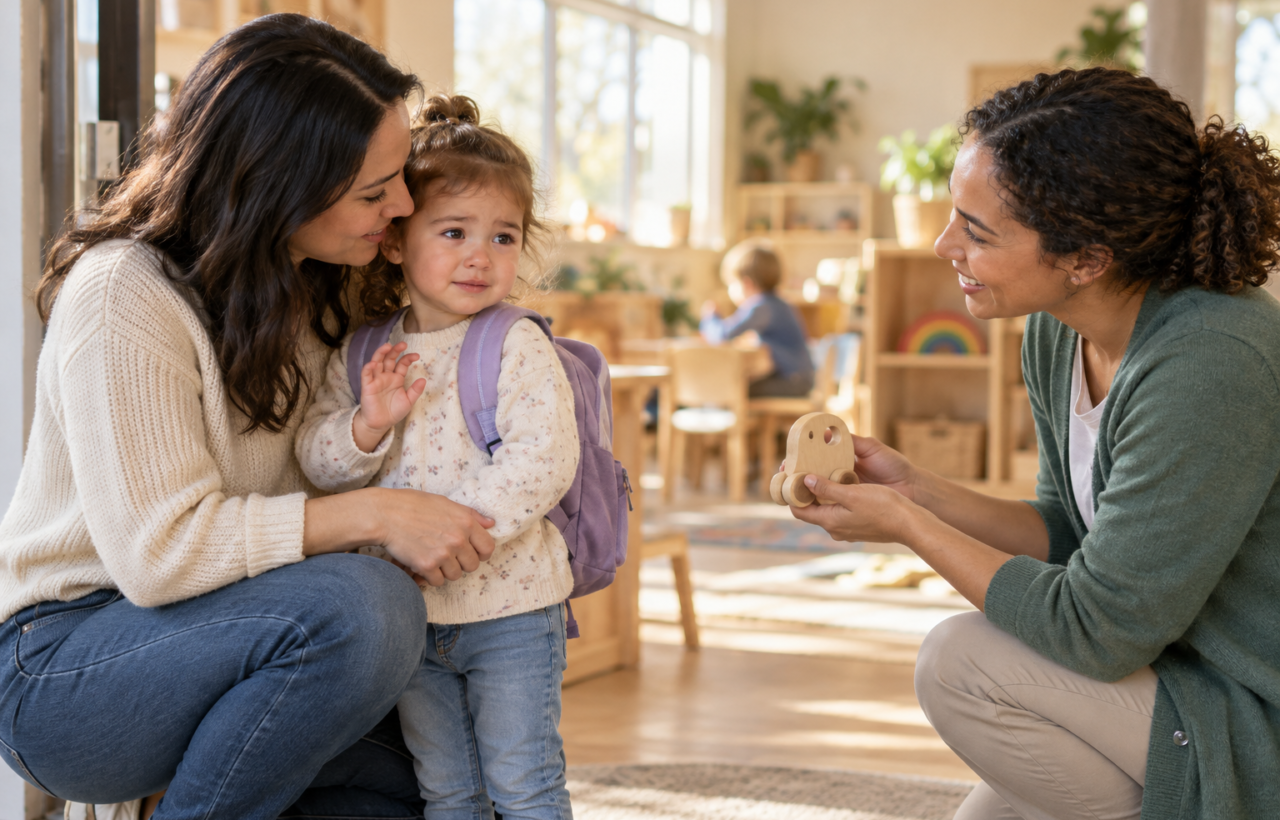
Your toddler locks onto your leg at daycare, cries when the babysitter arrives, or calls for you the moment you leave the bedroom. You may wonder whether to stay longer, slip away unnoticed, or cancel the separation altogether. A better plan is to make leaving clear, brief, and predictable.
The goal isn’t to stop every tear before you go. It is to help your child experience the same reassuring sequence: you say goodbye, a trusted caregiver keeps them safe, and you return. Separation anxiety is a normal part of early development. It can emerge as early as 6 months and is often strongest between 8 and 18 months, although every child follows a different timeline.
Key takeaways
- Tell your toddler that you’re leaving. Sneaking out may avoid one difficult moment, but it can make your departures feel less predictable.
- Use one short goodbye routine: a simple explanation, one affectionate gesture, one familiar phrase, and then leave.
- Describe your return using an event your child recognizes, such as after nap or after afternoon snack, rather than an abstract promise such as soon.
- Arrange for the receiving caregiver to begin a familiar activity immediately after the handoff.
- Judge the situation by what happens after you leave, not only by how loudly your toddler protests at the door.
- Seek professional guidance when distress is extreme, prolonged, physically intense, or connected to a concern about a particular care setting.
Use the same short goodbye every time

A toddler can understand that you are going away without yet understanding how long the separation will last. Five minutes and an entire workday can both feel like an undefined absence. That is why repeating ‘I’ll be back soon’ often does less than parents hope: young children do not yet comprehend time as adults do.
Make the departure concrete instead. If the schedule is reliable, say, ‘You will play with Sam, have lunch, and take your nap. I will come back after nap.’ For a shorter separation, you might say, ‘Grandma will stay with you while I go to the store. I will come back after your snack.’ Use an event only if you can realistically return when you said you would.
A workable handoff has five parts:
- Prepare the caregiver. Agree on who will receive your child, which activity will be ready, whether a comfort item is permitted, and when the caregiver will update you.
- Say what is happening. Give a brief warning in plain language: ‘We are going to daycare. Priya will look after you while I work.’
- Name the feeling without arguing with it. Try, ‘You want me to stay. It is okay to miss me.’ You don’t need to convince your toddler that they are happy.
- Complete one familiar ritual. Use the same hug, kiss, wave, or short phrase each time. Keep it small enough to repeat even on a rushed morning.
- Transfer care and leave. Let the caregiver begin the planned activity. Unless there is a genuine safety or care concern, don’t return for another round of hugs.
Lingering can accidentally turn the goodbye into a negotiation. Returning each time your toddler cries may also communicate that something about the handoff is uncertain. A calm departure does not require you to feel calm inside; it means your actions and words remain steady.
Do not disappear while your toddler is absorbed in a toy. Sneaking away can lead to more clinginess because your child cannot tell when another disappearance might happen. It is fine for a caregiver to redirect them after you have said goodbye. The important distinction is that the activity follows an honest departure rather than concealing it.
If watching the crying makes you likely to go back, ask the caregiver to send one factual update after your child has had time to transition. Agree on this before the handoff so you are not messaging repeatedly while they are trying to help your toddler settle.
Adjust the routine to the kind of separation

Daycare or a babysitter
Ask the caregiver to have something specific ready at the moment of transfer: a favourite puzzle, a simple song, a job such as carrying a book, or another familiar activity. The task gives the caregiver a way to connect with your child once the goodbye is complete.
If the setting permits comfort objects, let your toddler choose a safe item associated with home. Make sure the child can reach it when needed rather than treating it as a reward that an adult controls. Confirm the setting’s safety and hygiene rules before sending anything from home.
At pickup, resist measuring the day by the drop-off alone. Ask the caregiver two concrete questions: ‘What happened after I left?’ and ‘What was my child able to do once the initial distress eased?’ Many handoff outbursts subside after the caregiver is out of view. A tearful goodbye followed by play, eating, rest, and connection is a different pattern from distress that continues through much of the day.
Bedtime and naps
Sleep can provoke separation anxiety because bedtime and naps are among the longest regular stretches when a toddler is apart from you. Create a sequence with an unmistakable ending. For example: pyjamas, one book, one song, a kiss, the same goodnight phrase, and then lights out.
If your toddler protests after the routine, respond according to your family’s sleep plan with the same calm language. Avoid restarting the entire sequence unless your child has a real need, such as illness, pain, a wet diaper, or an unsafe situation. Restarting every step can make the endpoint less predictable.
A soothing routine helps because it signals that separation is approaching before you reach the moment of leaving. It should be repeatable, not elaborate. A routine that depends on a long performance is difficult to maintain when another caregiver handles bedtime or the family is away from home.
Family gatherings and unfamiliar places
A room full of friendly relatives can still feel overwhelming to a toddler. Stay close while your child takes in the setting. Let them show interest before encouraging contact, and do not pass them to another adult simply because that person is eager to hold them.
Your toddler may approach someone and then retreat to you a moment later. Treat that return as information, not misbehaviour. Offer contact, let them reset, and give them another opportunity to explore when they are ready. Pushing a distressed child beyond their limit can make the next group situation more difficult.
Expect progress to include difficult days
A toddler who has managed daycare comfortably for weeks may suddenly cling again. Illness, stress, a vacation, a move, or another disruption to the usual routine can bring separation anxiety back for a while. There is no single age or timetable by which every child stops experiencing it.
When the crying returns, look for what changed before redesigning the entire goodbye. Check the caregiver, room, schedule, sleep routine, recent illness, travel, and changes at home. Then restore as much predictability as you reasonably can. Keep the familiar phrase and gesture even if other parts of the day have shifted.
If the pattern is hard to read, make a brief handoff log. Record the setting, what happened before the separation, how your toddler reacted, what the caregiver observed after you left, and what helped them reconnect. The purpose is not to score your child or demand daily improvement. It is to distinguish a concentrated goodbye protest from distress that persists across people, places, and activities.
Define progress broadly. Useful changes may include accepting comfort from the caregiver, beginning an activity sooner, eating or resting normally after the handoff, or recovering from a setback with the familiar routine. A tear-free doorway is not the only sign that your toddler is learning to manage separation.
Know when the pattern needs a closer look

Crying, clinging, and objecting at separation can all occur during normal toddler development. The volume of one goodbye does not diagnose a problem. What matters more is the intensity, persistence, physical effects, impact on daily life, and whether the fear appears across settings.
Contact your child’s health care provider when the anxiety is extreme or prolonged, does not ease after separation, or repeatedly interferes with eating, sleep, play, or the ability to connect with a trusted caregiver. Vomiting, repeated nightmares, physical symptoms, and unrelenting worry also warrant professional guidance. These signs do not establish a diagnosis on their own; they are reasons to ask for an assessment.
Bring specific observations to the appointment: when the behaviour began, which separations trigger it, what happens after you leave, whether it occurs with several caregivers, any physical symptoms, and recent changes at home or in care. A caregiver’s factual account of the period after drop-off can be especially helpful.
Take a setting-specific change seriously. If your child suddenly fears one person or place, does not settle there, or you have another reason to question their safety or care, investigate that concern rather than assuming it is ordinary separation anxiety. Ask the caregiver and supervisor for concrete observations. If you believe your child may be unsafe, pause that care arrangement while you seek appropriate help.
Before the next separation, choose one truthful return phrase, one goodbye gesture, and one handoff activity with the caregiver. Then follow the sequence once. Your toddler may still cry, but the goodbye will have a shape they can learn: you tell them you are leaving, they are cared for, and you come back.
References




