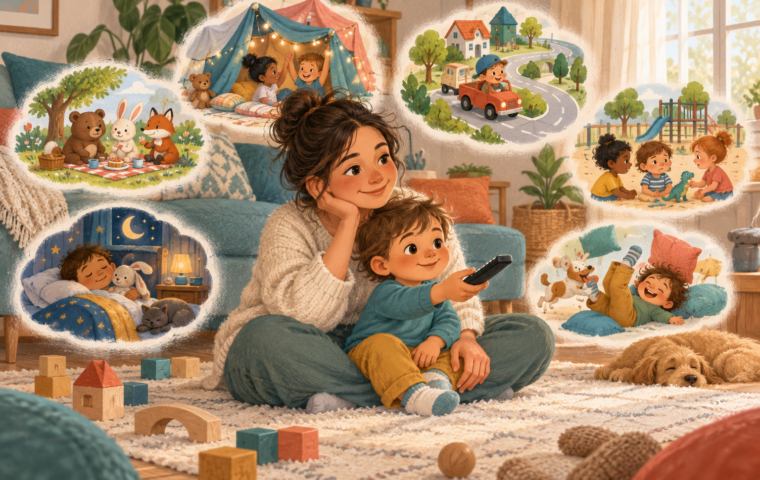
If your day with a baby or toddler already feels full, language development doesn’t need to become another scheduled activity. You can build it into getting dressed, eating, walking, playing, bathing, and settling down with a book.
The goal isn’t to say as many words as possible. It is to create small exchanges in which your child can notice a word, connect it with something meaningful, and take a turn in whatever way they can. A look, reach, sound, gesture, or word can all keep the exchange going.
Start with what already has your child’s attention

Language is easier to make meaningful when you talk about what your child is already looking at, touching, requesting, or doing. If your baby is staring at the ceiling fan, naming the cup in your hand creates a weak connection. Saying, “Fan. The fan is turning,” matches the word to the moment.
Use this simple pattern during ordinary activities that can support language skills:
- Notice what has your child’s attention.
- Name the object, action, person, or feeling in a short phrase.
- Add a small piece of information.
- Pause so your child has room to respond.
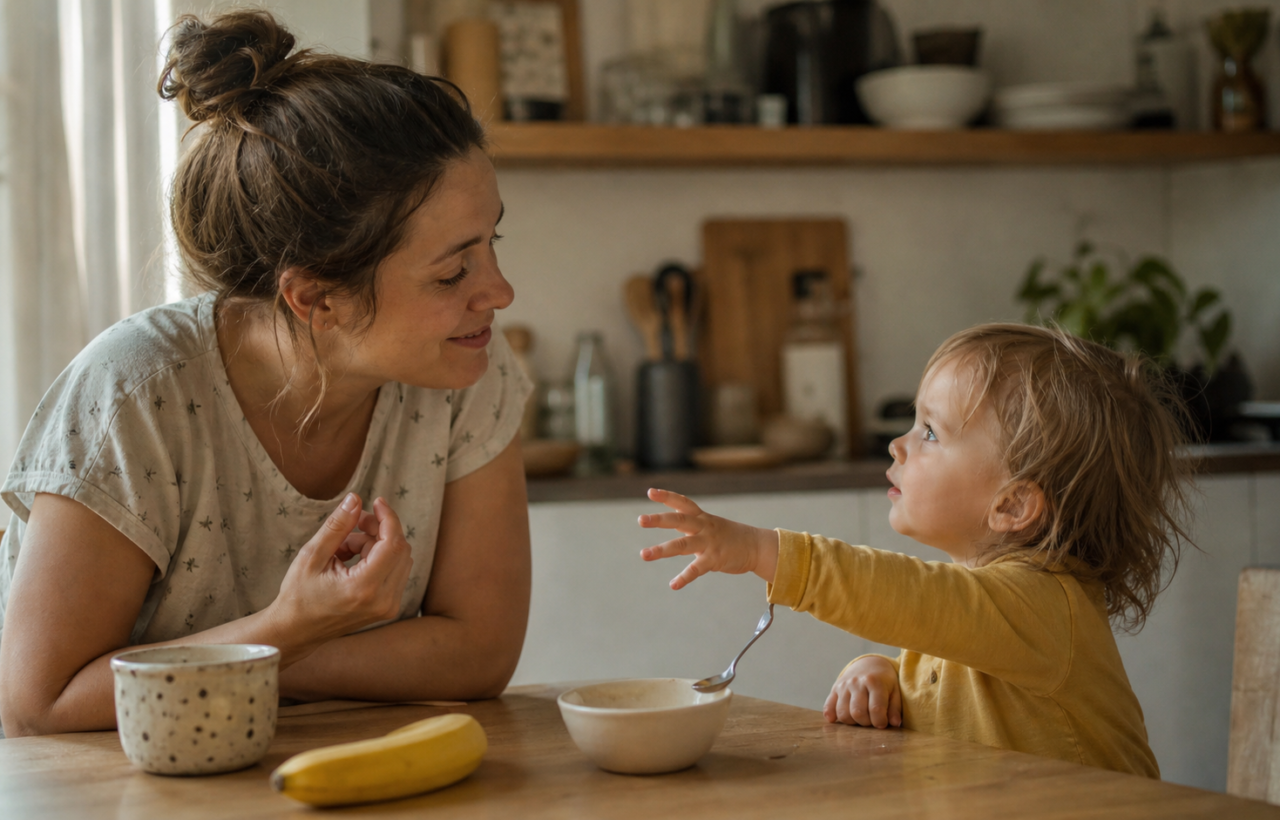
If your baby reaches for a banana, you might say, “Banana. You want the banana,” and then respond to the reach. If your toddler pushes a truck up a cushion, try, “Truck goes up. Now it is at the top.” The words describe something your child can see and care about right then.
You don’t need to narrate every second. Constant talking can leave no opening for your child. Say something short, then watch. Their next turn might be a glance, a smile, a movement, an imitation, or an attempt at a word. Answer that turn as if it matters, because it is part of the conversation.
Model the next step without demanding it
A useful model sits just beyond what your child communicated. You aren’t testing them or asking them to copy you. You are showing them a slightly fuller way to express the same idea.
| What your child does | What you can do | What that can sound like |
|---|---|---|
| Looks, reaches, points, or makes a sound | Name the likely message and respond | “Cup. Here is your cup.” |
| Uses a single word | Repeat it and add a useful word | “Dog.” becomes “Big dog” or “Dog running.” |
| Combines a few words | Model a natural sentence and add an idea | “Baby sleep” becomes “The baby is sleeping. Blanket on.” |
| Uses a longer sentence | Respond to the meaning and continue the exchange | “The truck is stuck under the chair.” becomes “It is stuck. How can we get it out?” |
Your child does not have to repeat the expanded version. Hearing it in a relevant moment is the practice. Requiring a performance after every model can turn a useful exchange into a test.
The same principle applies when pronunciation or grammar isn’t complete. If you understand the message, respond naturally and include the clearer form in your reply. A child who says, “Tat run,” might hear, “Yes, the cat is running.” You have supplied a model without interrupting the thought to announce a correction.
If you genuinely don’t understand, avoid pretending. Show what you did understand, then ask for another clue: “You want something from the table. Can you show me?” Offering two real possibilities can also help: “Do you mean the cup or the spoon?” Accept the point, look, sound, or word that answers you.
Give familiar routines a language job
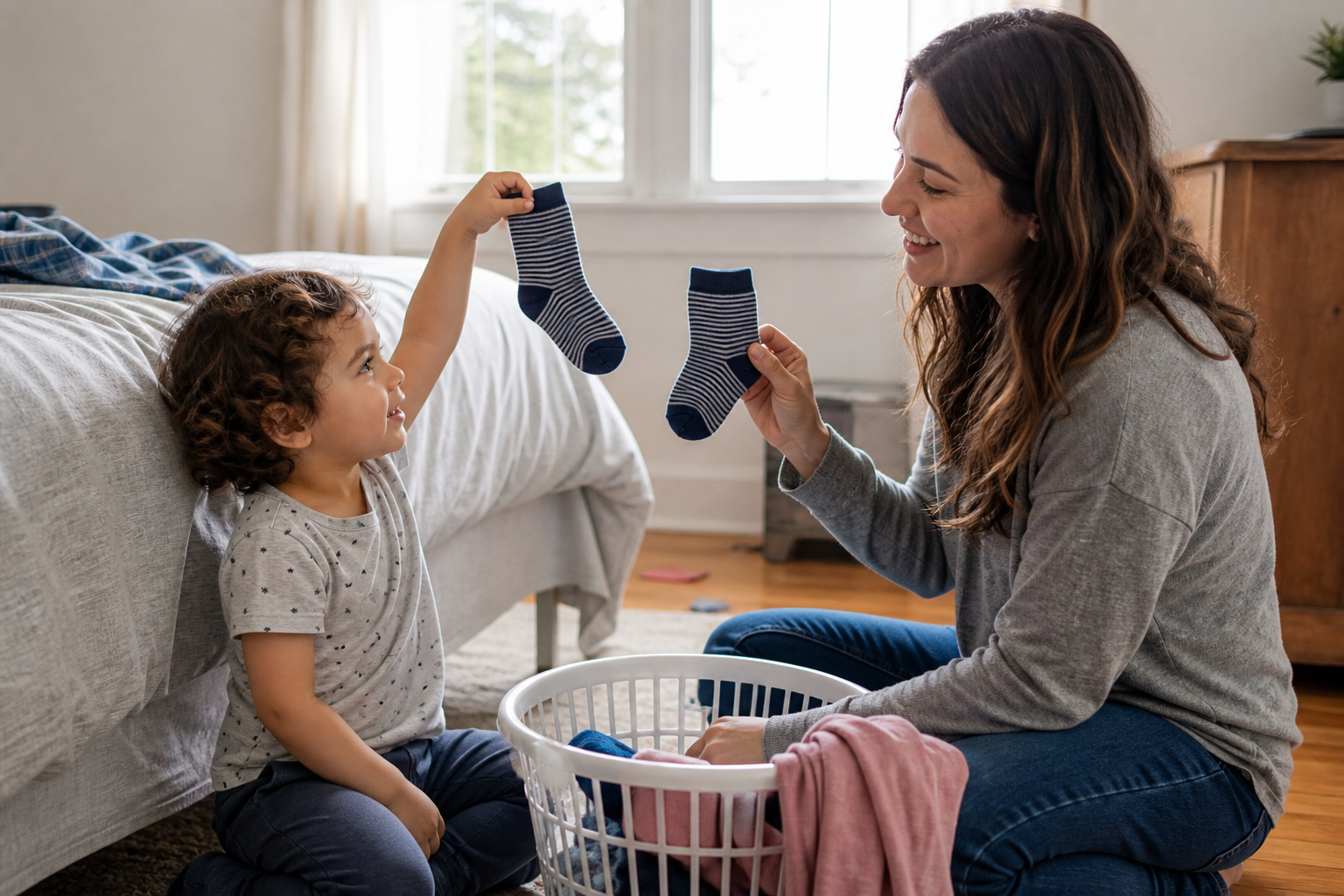
Repeated routines are useful because the objects and actions are already present. Your child does not have to imagine what “sock on” means while you are putting on a sock. The same useful words return naturally the next time you do it.
- Dressing and diaper changes: Name body parts, clothing, actions, and the order of events. Try phrases such as “Arm in,” “Zip up,” “Wet diaper off,” or “Clean diaper on.” Pause at a familiar point to let your child anticipate what happens next.
- Meals and snacks: Name foods, utensils, textures, and actions such as pour, cut, stir, bite, more, and finished. Offer a choice only when both options are genuinely available: “Banana or toast?” Never delay food or drink to force a spoken word; a gesture, look, or sound can be a valid request.
- Bath time: Pair words with visible actions: “Water pouring,” “Wash your foot,” “Duck under,” or “Bubbles gone.” Keep your full attention on your child in the bath. A language game never replaces close supervision around water.
- Walks and errands: Notice a few things your child selects rather than naming everything in sight. If they stop for a dog, you can talk about that dog: “Small dog. The dog is sniffing.” Reuse the important word if the dog appears again.
- Play and cleanup: Follow the play before trying to direct it. Add words for actions and locations: “Block on,” “Car under the bridge,” or “Bear is hiding.” During cleanup, use the same vocabulary with a new purpose: “Cars in the basket.”
- Books and songs: You don’t have to read every line or finish every page. Name a picture your child touches, connect it to their life, or pause during a familiar song. Letting your child turn back, repeat a favourite part, or supply a sound keeps the experience interactive.
You do not need to use all of these routines at once. Choose one that happens reliably and attach a small language habit to it. During dressing, for example, you might consistently name the clothing item, describe the action, and pause before the next step. A routine you can actually repeat is more useful than an elaborate activity you rarely have time to do.
Protect the back-and-forth part of the interaction
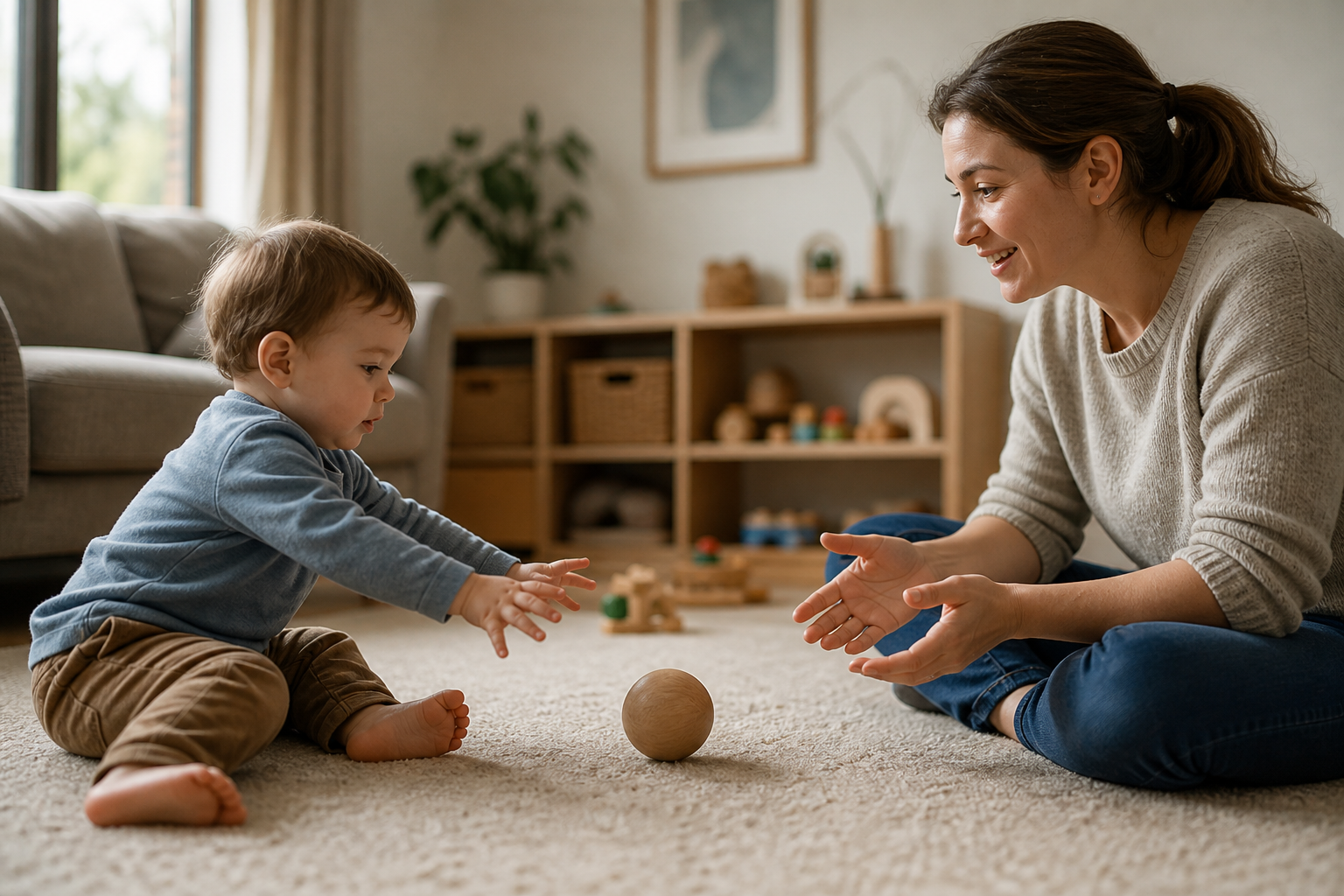
Talking near a child is not quite the same as talking with them. The difference is whether their behaviour changes what happens next. When your child points to a bird and you answer, the point has affected the conversation. When they make a sound and you imitate it, then wait, they have a reason to take another turn.
Position yourself where your child can comfortably hear you and, when useful, see your face or the object you are discussing. You do not need to insist on eye contact. Attention can show up as stillness, a hand movement, a repeated action, a sideways glance, or returning to the same object.
Questions can invite a turn, but a stream of questions can feel like a quiz. If you ask, “What is that? What colour is it? What does it say?” your child has to prove what they know. Comments give language without that pressure: “A blue truck. It is making a loud sound.” You can still ask a genuine question when the answer will affect what you do next.
Key takeaways
- Follow your child’s attention before adding words.
- Use short phrases that match the object or action in front of them.
- Treat looks, gestures, movements, and sounds as conversational turns.
- Add a small step to your child’s message instead of demanding a repetition.
- Comment more often than you quiz.
- Leave quiet space after you speak.
- Repeat a manageable language habit inside a routine you already do.
Know when everyday practice is not enough
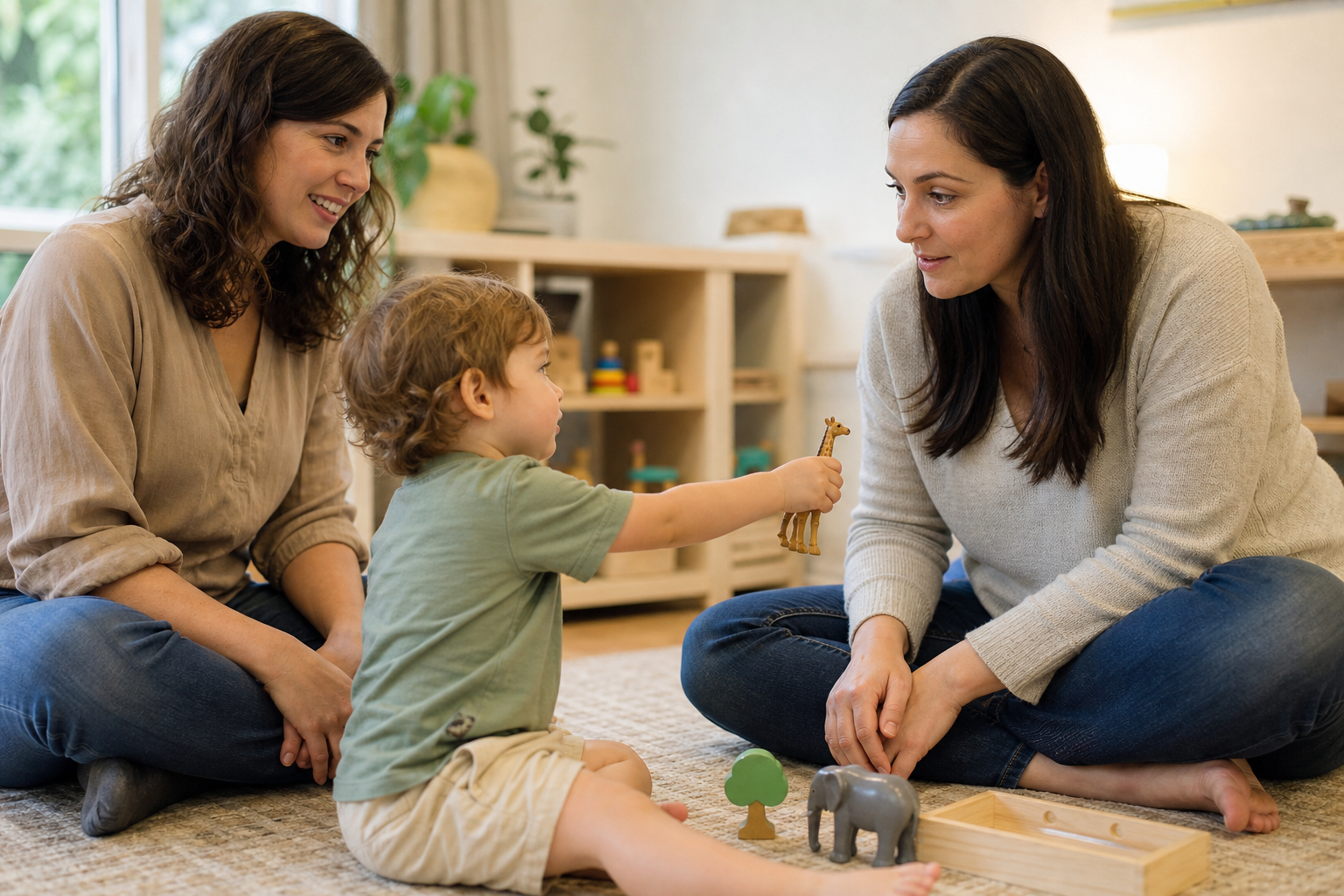
Everyday interaction can support communication, but it cannot tell you why a child is having difficulty, and it is not a substitute for an assessment or individualized therapy.
Contact your child’s health-care provider if your child loses communication skills they previously used, seems not to hear or respond to sounds, or if you are concerned about how they understand, express themselves, or interact. You do not need to wait until you can prove that something is wrong. Ask whether an evaluation by a speech-language pathologist or a hearing assessment would be appropriate.
Concrete observations will make that conversation more useful. Note how your child requests help, which gestures, sounds, or words they use, what kinds of directions they appear to understand, whether anything has changed, and what other caregivers notice. Tell the professional which languages your child regularly hears and uses so they have the right context.
For now, pick a routine that will happen again soon. Follow what catches your child’s attention, name it simply, add a little meaning, and pause. That small opening gives your child something more valuable than a lesson to complete: a real turn with you.
References